
What the World Cup Reminded Us About Soccer's Head Injury Blind Spot and How We're Helping Close It
This summer's FIFA World Cup was historic before a ball was even kicked: the first tournament hosted across three countries, the first at 48 teams, and by most measures the most-watched World Cup ever played. It was also a tournament that, like nearly every major soccer event in recent memory, put a spotlight back on an injury risk the sport has spent decades treating as routine - knocks to the head and face.
Coverage during the tournament pointed to something soccer has historically underdiscussed: unlike a hard tackle or a collision, a header is not treated as an "injury event" at all. It's a skill. Commentators praise a well-timed header the same way they praise a clean pass. But a skill that involves repeatedly meeting a moving ball with your head is also, unavoidably, a repeated head impact, and soccer has had far less data on that reality than sports like rugby or American football, where contact is treated as the obvious hazard it is.
That gap is exactly what a research project coordinated by FIFPRO, the global players' union, and the Amsterdam University Medical Centers has set out to close, and it's a project Prevent is proud to be part of.
A sport with almost no data on its most routine head impact
"We do not have a lot of data on heading, especially," says FIFPRO's Director of Medical, Prof. Dr. Vincent Gouttebarge, a former professional footballer who played 14 seasons in France and the Netherlands. "We have some data with regards to the frequency of heading during matches, but we have much less about the number of headers during training and almost nothing available about the forces associated with headers."
That last gap, force, not just frequency, is the heart of the problem. Soccer has generally discussed heading in binary terms: did a player head the ball, or didn't they? But a header off a corner kick, a header off a long goalkeeper clearance, and a header in a five-a-side training drill are not the same event for the brain. As Dr. Gouttebarge put it, "a long kick from a goalkeeper of 50 or 60 metres that leads to a header has a different force and a different impact compared to when you throw the ball." Without measuring that difference, it's nearly impossible to write guidelines that mean anything.
How the research works
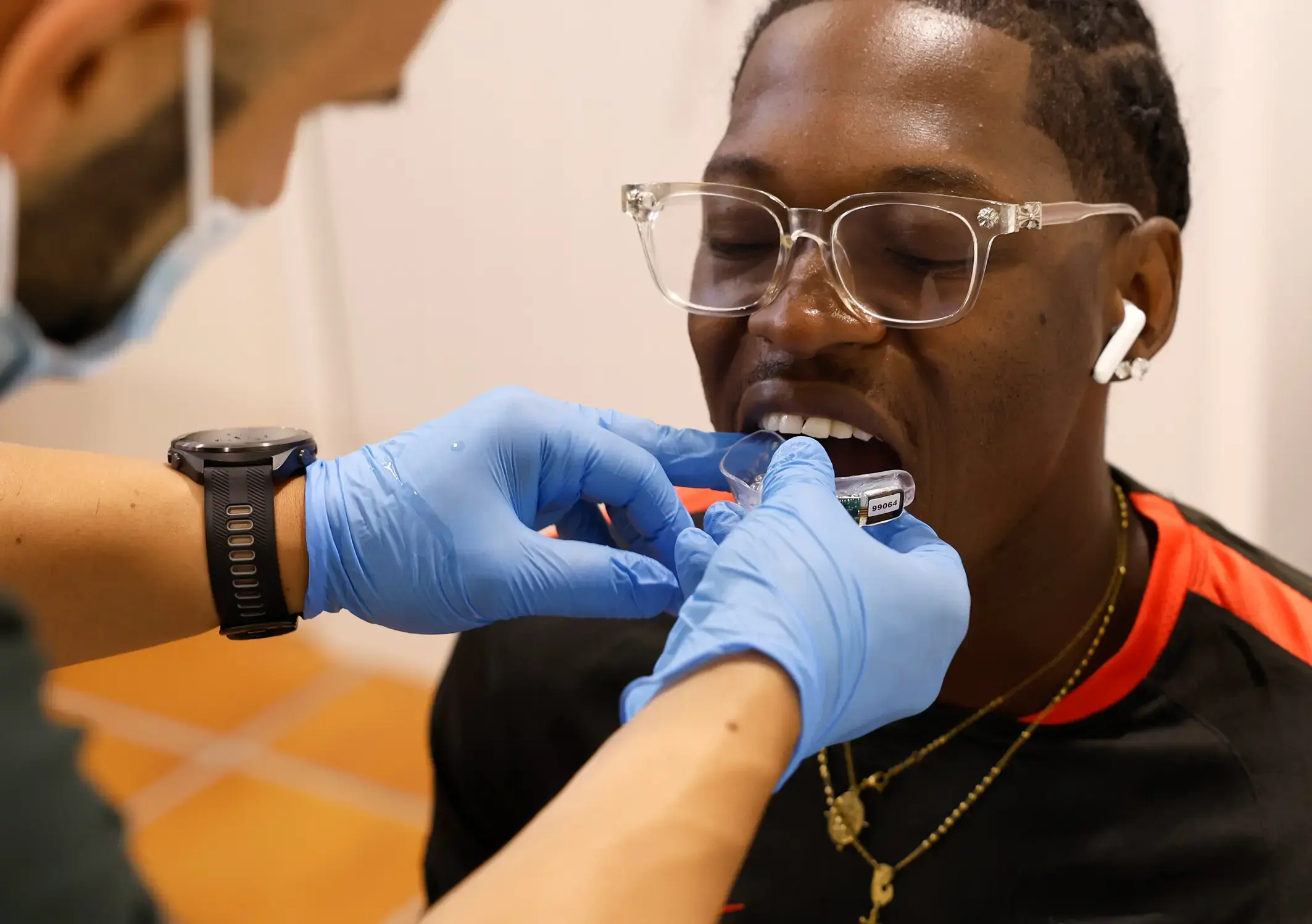
This is where Prevent's instrumented mouthguards (iMGs) come in. Players in the study wear our mouthguards during training and matches, which capture the force of every head impact in real time. Researchers then cross-reference that data with match and training video, linking each measured impact to the specific header, tackle, or collision that caused it - the same core approach we use in our rugby and American football research partnerships, now applied to the world's most-played sport.
Data collection has already taken place in Malta, the Netherlands, Finland, England, and Portugal, gathered largely during player-union training camps, including sessions for out-of-contract players, and in partnership with clubs. That approach let researchers reach a wide range of players without requiring any single squad to wear sensors for an entire season. Uptake has been strong in training, with roughly three-quarters of participating players wearing the mouthguards during sessions. Players are also surveyed after sessions to estimate their own header count, giving researchers both the objective sensor data and a player's own sense of their exposure to compare it against.
Dr. Freja Lahteenmaki, a former professional player in Denmark's top flight now practicing medicine in Finland, is running part of this research as her PhD. "As a former player, I have seen many of my former teammates experience the effects of head impacts and concussions," she says. "When we look at brain health in footballers, we look at the cumulative load on the brain — and that consists of the impact magnitude, as well as the frequency of impact. We know there's a lot of studies done in rugby and American football, and this is important to explore more in football, where we intentionally use our head."
Why measuring force could change the guidelines
Current heading guidance in youth and amateur soccer already limits exposure in training, but those limits are largely built on caution rather than measurement - nobody has been able to say, with real data, what actually counts as a "high-force" header. "If we have more data about the force associated with heading, then potentially we can put a number to that," Dr. Gouttebarge says. "That could help us have more valid, quantified guidelines for players."
No single study will settle a question this important on its own. Dr. Gouttebarge is clear that FIFPRO's findings will need to sit alongside other high-quality research before any guideline changes are made. But turning "heading seems risky" into an actual, measured number is the necessary first step, and it's one that simply wasn't possible before this kind of on-field sensor data existed.
What this means for the next generation of players
The project's next phase extends data collection to women's professional players, an important expansion, given how much less research has historically included women's soccer at all, despite evidence that female athletes experience concussions at higher rates in comparable sports.
For Prevent, this partnership is a continuation of the same mission that brought us into rugby stadiums, NCAA programs, and military training grounds: putting real, objective data behind decisions that used to rely on guesswork. Soccer is played by more people, at more levels, than almost any sport on earth. From World Cup finals to Saturday morning youth leagues where a header is just part of learning the game. If this research can turn "we think heading carries some risk" into "here's what a high-force header actually looks like, and here's how often it happens," it gives the entire sport, federations, coaches, and parents alike something it has never really had: a number to build real guidelines around, instead of a guess.
That's a slower, less dramatic headline than anything that happened on the pitch this summer. But it may end up mattering more for the players who'll be heading a ball long after this World Cup is forgotten.
Prevent Biometrics is proud to provide the instrumented mouthguard technology supporting FIFPRO and the Amsterdam University Medical Centers' research into head impact exposure in professional football. See how it works