
What Are Work and Workload? Understanding Head-Impact Exposure Beyond G-Force
When people talk about head impacts, g-force is often the number that gets the most attention. But peak acceleration is only one way to describe what happened during a Head Acceleration Event (HAE).
Prevent's instrumented mouthguard (iMG) measures head motion during sport and generates several metrics that help characterize recorded HAEs. Two of those metrics, Work and Workload, provide additional context about individual events and how exposure accumulates over time.
First, what is a Head Acceleration Event?
A Head Acceleration Event (HAE) occurs when an external force causes measurable acceleration of the head. This can result from direct contact to the head or from force applied elsewhere on the body that causes the head to move.
Importantly, an HAE isn't necessarily the same thing as a contact or collision.
A single collision can result in multiple HAEs. For example, an athlete may experience an initial tackle, contact from another player and then contact with the ground, each potentially producing a separate HAE. Likewise, not every contact necessarily results in a recorded HAE.
That distinction matters when we're trying to understand exposure. Simply counting tackles, collisions or even HAEs captures only part of the picture.
What is Work?
Work estimates the kinetic energy transferred during an individual HAE and is measured in joules (J).
Prevent calculates Work using both the translational (linear) and rotational components of head motion. This gives another way to characterize an HAE beyond looking at peak acceleration alone.
Why is that useful?
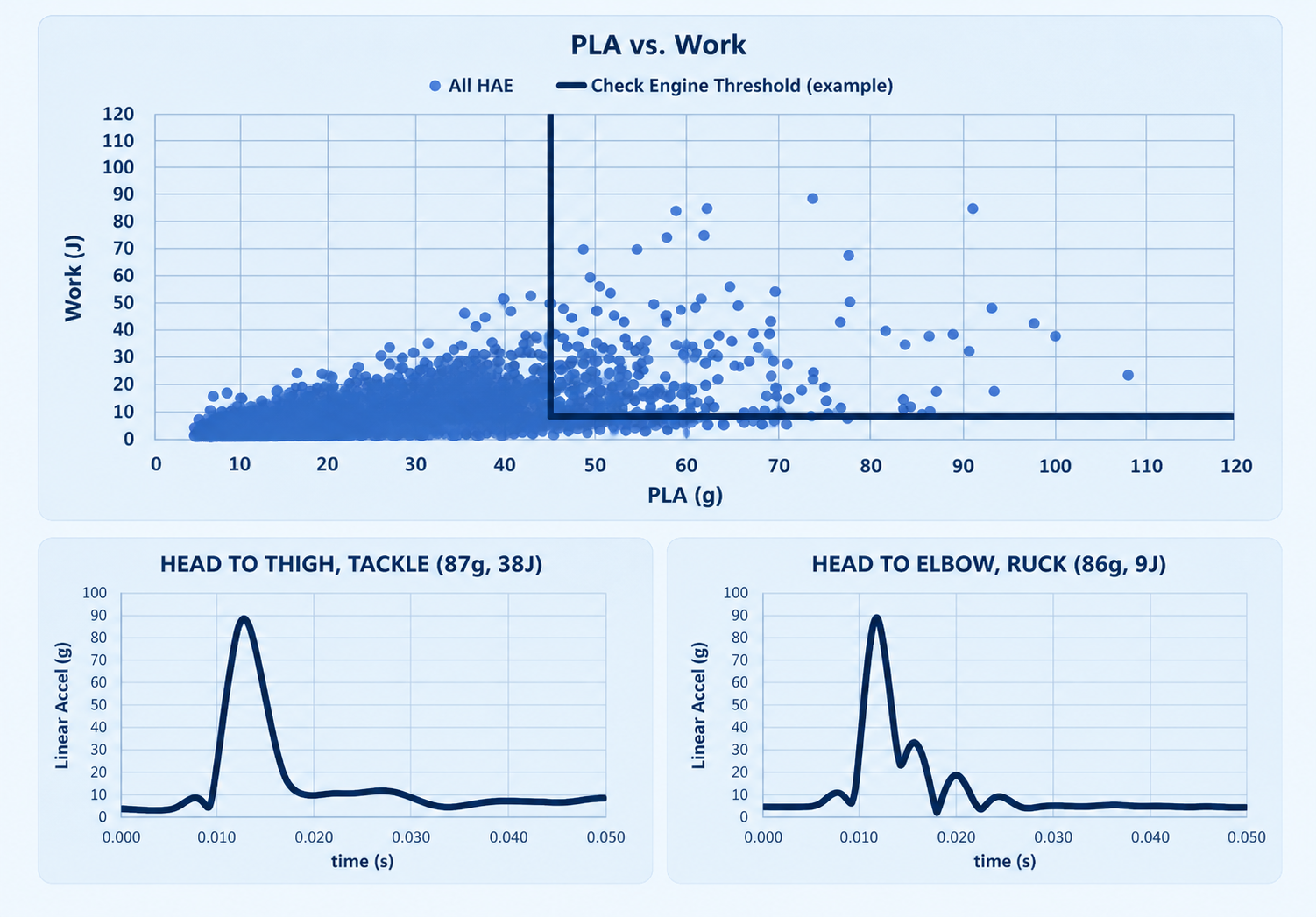
Two HAEs can have similar Peak Linear Acceleration (PLA) values while differing in other characteristics, including the duration of the event. As a result, events with similar peak acceleration can have different Work values.
The type of contact plays a part. HAEs with higher Work tend to occur when the head meets a larger, softer mass, such as the ground or another player's shoulder, hip or thigh, which produces a longer impact pulse. Glancing or rigid contacts, such as an elbow, tend to produce a shorter pulse and lower Work.
What is Workload?
If Work helps characterize an individual event, Workload helps describe how that exposure accumulates.
Workload is calculated by adding together the Work associated with multiple HAEs. It can therefore be examined across different periods, including a training session, game or longer period of participation.
The distinction is simple:
One HAE = Work
Multiple HAEs = Workload
This means two athletes could record the same number of HAEs but accumulate different Workloads depending on the characteristics of those events.
Similarly, an athlete could experience different Workloads across two sessions even if the number of recorded HAEs was similar.
How does this relate to head-impact exposure?
Head-impact exposure is the broader picture created by looking at HAEs and their characteristics over time.
Prevent reports several measurements that can contribute to understanding that picture, including:
- Peak Linear Acceleration (PLA): peak linear acceleration of the head, measured in g.
- Peak Angular Acceleration (PAA): peak angular acceleration of the head, measured in rad/s².
- Peak Linear Velocity (PLV): peak linear velocity of the head, measured in m/s.
- Peak Angular Velocity (PAV): peak angular velocity of the head, measured in rad/s.
- Work: estimated kinetic energy transfer associated with an individual HAE, measured in joules.
- Workload: cumulative Work across multiple HAEs.
These measurements provide different information rather than competing to produce one definitive “impact score.”
A useful way to think about them is:
- HAE = an event was recorded
- PLA / PAA / PLV / PAV = characterize how the head moved
- Work = estimates kinetic energy transfer associated with the event
- Workload = shows how Work accumulates across multiple events
- Head-impact exposure = the broader picture across events and time
Why look beyond impact count?
Because not every HAE is the same.
Counting events tells you how many HAEs were recorded. Measurements such as PLA, PAA, PLV and PAV provide information about the head motion associated with those events. Work adds another measure for characterizing an individual HAE, while Workload provides a way of examining cumulative exposure across multiple events.
Together, these data can help researchers, sports organizations and performance teams investigate differences in head-impact exposure between athletes, activities and periods of participation.
Does higher Work or Workload mean an athlete is injured?
No.
Work and Workload describe characteristics of measured HAEs and exposure. They are not measures of concussion, brain injury or injury risk.
There is no single iMG measurement metric that can determine whether an athlete has sustained a concussion. Concussion is a clinical diagnosis based on signs, symptoms and appropriate medical assessment.
This distinction applies across head-impact data: measurement provides information about what the head experienced; it does not diagnose the athlete.
The takeaway
Peak acceleration is useful, but it doesn't describe every aspect of a Head Acceleration Event, and counting events alone doesn't show how exposure accumulates.
Work helps characterize an individual HAE. Workload helps show how that exposure accumulates across multiple HAEs.
Used alongside other iMG metrics, they provide additional context for understanding head-impact exposure over time.
Disclaimer: This article is for general informational purposes only and is not medical advice. Prevent's iMG provides head-impact measurement data. It does not diagnose any medical condition, and its data should not be used as a substitute for assessment by a qualified healthcare professional. Any athlete with a suspected head injury should be removed from play and assessed by a medical professional.