
What Is a Head-Impact Alert Threshold?
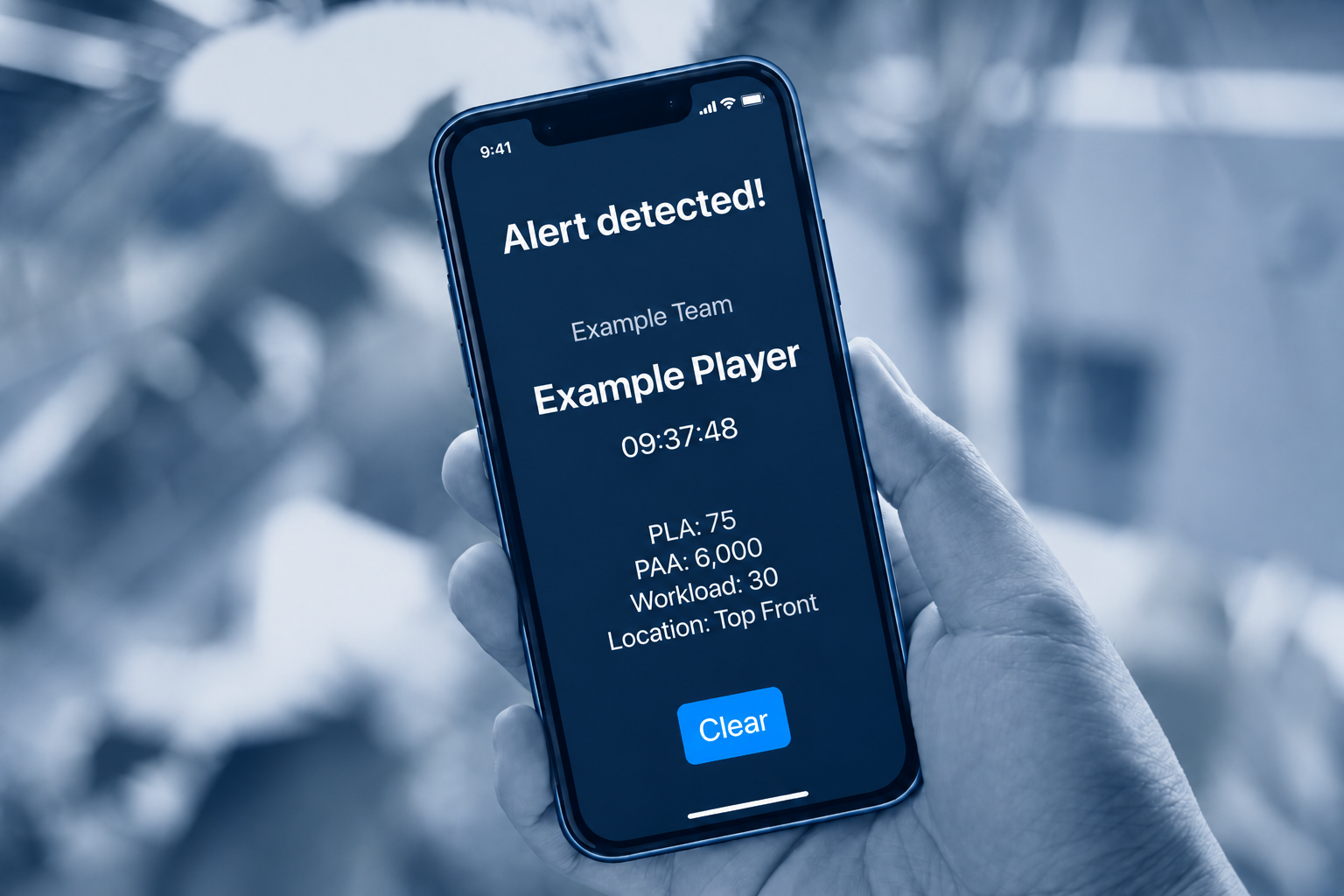
Not every head impact triggers an alert. So when an instrumented mouthguard records a head impact, one of the first questions is often: what makes an impact trigger an alert?
The answer is an alert threshold: a configured measurement level used to determine when a measured head-impact event should be brought to attention in real time.
Importantly, an alert threshold is not a concussion or injury threshold. It determines when an alert is generated, not whether an athlete has sustained an injury.
How does a head-impact alert work?
Prevent's instrumented mouthguard (iMG) uses integrated accelerometers and gyroscopes to measure how the head moves during an impact, including linear and rotational motion.
When a measured event meets the configured alert criteria, Prevent can provide an immediate visual alert through the mouthguard's red LED and deliver event information to authorized users through the Prevent app.
In simple terms, the sequence looks like this:
- Head impact: the head accelerates as a result of contact.
- Measured: the iMG measures the linear and rotational motion of the head.
- Threshold met: the measured values meet the configured alert criteria.
- LED turns red: the mouthguard provides a visual alert.
- Sideline app alert: event information is delivered to authorized users through the Prevent app.
This brings qualifying head impacts to attention in real time, allowing sideline personnel to check in with the athlete and, where appropriate, consider the event alongside other information such as observation, reported symptoms, video and clinical assessment.
An alert provides an additional piece of objective information. It does not diagnose concussion or determine whether an injury has occurred.
What measurements can be used for an alert threshold?
Head motion can be characterized using several measurements. Two commonly used measures are:
- Linear acceleration describes how quickly the speed of the head changes in a straight line and is commonly expressed in g.
- Angular (rotational) acceleration describes how quickly the rotational velocity of the head changes and is expressed in rad/s².
Depending on the application, configured alert criteria can use measurements such as these to determine when an alert is generated.
This is different from the mouthguard's recording or trigger threshold, which determines when the device begins recording a Head Acceleration Event (HAE). An iMG can therefore record many head-impact events that do not generate an alert.
Does a certain g-force mean an athlete has a concussion?
No. There is no single g-force or other instrumented-mouthguard measurement that can determine whether an athlete has sustained a concussion.
Concussion is a clinical diagnosis based on signs, symptoms, medical assessment and the circumstances surrounding the event.
Two athletes experiencing head impacts with similar measured acceleration may respond differently. Conversely, an athlete may require assessment based on symptoms, observed signs or another clinical concern even when a mouthguard alert has not been triggered.
That's why measurement and diagnosis are different things. Prevent measures head motion during an impact. Medical professionals assess the athlete.
How are alert thresholds established?
Alert thresholds aren't arbitrary numbers. They can be informed by statistical analysis of large datasets of real-world head acceleration events, helping researchers understand the distribution of impacts within a particular sport and population and identify unusually high-magnitude events.
Prevent has measured millions of head impacts in real-world sport, creating a large body of head-impact data across athletes and sporting environments. That type of population-level data can provide important context when establishing and refining alert criteria.
The appropriate threshold can also depend on the population and intended use.
How are alert thresholds used in elite rugby?
Elite rugby provides a real-world example of how head-impact alert thresholds can be incorporated into a broader medical process.
According to World Rugby's match-day guidance for medical staff, the elite threshold is currently set at 75 g and 4,500 rad/s² for men, and 65 g and 4,500 rad/s² for women. When a player's head acceleration event meets both criteria, an alert is sent to the independent match day doctor.
Within that specific protocol, an iMG alert is an indication for an off-field Head Injury Assessment (HIA1). World Rugby describes the alert as an additional indicator to the clinical process, not a replacement for it. Players are still removed for assessment based on clinical signs, even when there has been no iMG alert.
These thresholds have been set for a specific application and population, which is why the men's and women's figures differ. One threshold doesn't fit all, and these figures should not be interpreted as universal concussion or injury thresholds.
Why use an alert threshold at all?
Not every head impact is obvious from the sideline, and not every event will be reported by an athlete.
Instrumented mouthguards provide another source of objective information by measuring head motion directly. A real-time alert can bring a higher-magnitude event to the attention of sideline personnel, alongside existing methods such as observation and video review.
For other sporting environments, the way alerts are configured and acted upon may differ depending on the program, population and intended use.
The important distinction remains the same: an alert tells you that configured measurement criteria were met. It doesn't tell you that an injury occurred.
Alert thresholds and head-impact exposure are different
Real-time alerts are useful for bringing particular events to attention, but they are only one part of the information an instrumented mouthguard can provide.
Prevent also records head-impact data that can be reviewed over time to understand an athlete's broader head-impact exposure. That can include measures such as:
- Peak Linear Acceleration (PLA)
- Peak Angular Acceleration (PAA), also called Peak Rotational Acceleration (PRA)
- Peak Linear Velocity (PLV)
- Peak Angular Velocity (PAV), also called Peak Rotational Velocity (PRV)
- Work and Workload
- Frequency of recorded head-impact events
Looking at exposure over time answers a different question from a real-time alert. An alert highlights an individual event that meets configured criteria. Exposure data helps build a broader picture across multiple impacts, sessions and seasons.
The bottom line
A head-impact alert threshold is a measurement threshold, not a medical diagnosis.
When configured alert criteria are met, Prevent can bring a measured head impact to attention in real time, providing an additional objective data point that can support an appropriate check-in or assessment process.
Prevent measures head impacts, not concussion.
Disclaimer: This article is for general informational purposes only and is not medical advice. Prevent's iMG provides head-impact measurement data. It does not diagnose any medical condition, and its data should not be used as a substitute for assessment by a qualified healthcare professional. Any athlete with a suspected head injury should be removed from play and assessed by a medical professional.
- World Rugby Passport. IMG Alerts – Prevent. Concussion Management for Match Day Medical Staff using the HIA Protocol.
- World Rugby Passport. Match Day – During the match. Concussion Management for Match Day Medical Staff using the HIA Protocol.